

Social media growth relies on measuring content performance. Your posts and promotions need to do more than just “ fine” which is why you must optimize your strategy and content based on analytics. This helps you balance trend adoption with strategic decision-making.
To achieve this, you need to track social media metrics to understand how your efforts are making progress!
Just scheduling posts and engaging your audience is not enough for growth. You need to measure metrics, evaluate performance, refine your social media marketing strategy and create content that not only attracts but also delivers results.
So, let’s look at the top social media engagement metrics you should start focusing on today if you truly want to maximize your social media growth. Let’s get started!
What are Social Media Metrics?
Is this a new term for you or you are already familiar with it? Either way, let’s see what social media marketing metrics can do for you!
The term social media metrics refers to the analytics data that monitors, tracks and measures the impact you have made on social media. It helps you get a birds eye view on the performance of your strategy, content and engagement on social channels every time you share a post.
You can evaluate how well your brand or business connects with your target audience and community. The detailed insights you gather from metrics highlights what works best and what doesn’t, so you can fine-tune your strategy next time.
To make the most of this, you need to consider a complete list of performance, engagement and growth metrics for social media. By doing this you can stay confident in not overlooking areas that need attention or miss opportunities.
Why is it Essential to Measure Social Media Metrics?
Well, why do you think people share reels or posts on social media? Just to entertain you? No!, not just that. Creators are earning a lot of money through their content, while brands and businesses focus on multiplying ROI. Marketers and influencers on other hand plan to monetize form number of views, shares, likes, subscriptions and engagement.
But how do they manage it effectively? Only by measuring social media metrics. You can’t know if your audience likes the content you post, if they are truly engaging with your brand on social media or if your business is really growing through social media marketing strategy. That’s why it’s essential to identify which metrics work best for you to align them with your goals and objectives.
Key Social Media Metrics you Should Track
You must have your objectives, goals and key results figured out by now, but what about your social media strategy? If yes then lets see how to to use social media metrics to measure progress. For this you need to be aware of the following metrics, which have delivered results and helped drive growth.
Audience Growth Metrics
This metrics helps you to measure your audience growth on overall period of time. Let’s see the list of metrics that lets you keep track of your follower count and audience size.
Follower growth
By measuring follower growth, you can see how much your follower count has increased over time. This metric is calculated using the formula below:
Follower growth rate
This metric helps you measure the rate at which your followers are increasing or decreasing. You can calculate it using the following formula:
Audience size
By measuring audience size, you can understand the performance level of your social media channels and content. To track this, you should measure the increase in follower count quarterly, half-yearly and annually.
This metric is essentially derived from the two metrics mentioned above and tracking all of them together will give you a detailed view of your follower growth.
Brand Awareness Metrics
Brand awareness metrics is crucial in connecting the success of your social media strategy as it show how impactful you are using your strategy in creating brand awareness among the audience.
Reach
Reach signifies how many viewers have seen your post, basically highlighting how many people your post has reached.
Impressions
Measuring impressions helps you determine how many times a post appears on someone’s feed (audience). It can show how successful your content is in prompting people to view a single post multiple times.
However, knowing the number of impressions alone will not accurately indicate your post’s performance. It should be used alongside brand awareness and audience engagement metrics to assess the overall effectiveness of your content.
Video views
Measuring video views helps you assess how well your content performs and how many views it has actually received. You can also pair this metric with view duration, shares, engagement and impressions to determine how well your content connects with your audience. which helps you better understand the difference between reach vs. impressions vs. engagement.
Social Media Engagement Metrics
If you are not sure how to measure social media engagement metrics or if you are hearing about them for the first time, this section is for you. These metrics are crucial and cannot be ignored.
If you are serious about growing your social media presence, you must analyze your social media engagement metrics. Let’s look at the top metrics you should track to understand your engagement levels better.
Social Post engagement rate
This metric helps you measure the rate at which your audience interacts with and comments on your post. If the rate is high, then you’re ruling the show and your likes, shares & impressions will also spike rapidly.
Likes, Comments, Repost, Reactions etc
These metrics are like daily pills because they play an important role in determining the health of your content engagement. Knowing them will help you assess your content’s engagement over time and identify the types of content your audience interacts with the most.
Total Shares
Your audience will share your content only if they like it. Knowing the total number of shares helps you evaluate your content’s performance. It shows how much your audience prefers to share it with their family and friends. This can be a strong step toward increasing brand awareness.
Total Saves
If you are promoting educational or conversion-based content and your audience has saved it, it’s a strong sign that they like it and find it valuable. Measuring the total saves helps you understand this preference and fulfills the purpose of sharing that content.
Video completion rate
Let’s say you are going live, streaming a live event or sharing long-form content on social media. This metric helps you understand who stayed until the end and who watched the content from start to finish.
Brand Health Metrics
For instance, if you want to know how much your social media marketing has contributed to your brand’s growth and success. Measuring the related metrics will help you determine how familiar your audience is with our brand. So check out how much your content has contributed to brand awareness.
Audience sentiment
Go through your audience’s comments, analyze their tone,and observe the emotional connection they have with your brand. This helps you understand how much your audience truly values what you offer. This metric also helps you understand their behavior, preferences and needs.
Brand Mentions
Check whether your audience is willing to mention your brand to others even if they don’t tag you. This increases brand visibility and shows how well your brand is being received by your audience.
Share of Voice
This metric helps you assess how your brand has a unique voice amidst your competitors. It also measures your position in the market and how many people are actually talking about you. This is one of the important metrics for social media marketing that you should never miss out. The formula to calculate it is:
Metrics to Monitor Customer Satisfaction
Customer satisfaction is a key social media metrics to track as it determines whether your customers or audience are satisfied with your offerings. You can measure this using the following metrics:
Reply Time
You should track how long it takes you to respond to your customers’ DMs and inquiries. Nowadays, audiences prefer personalized customer service and even appreciate being contacted directly by the brand. Prompt responses are the best way to achieve the highest customer satisfaction rate.
Total Response Volume
This metric measures the total number of responses your team provides to customers. It helps you track whether any messages go unanswered on social media, preventing exhausting incidents. Increasing your response volume can enhance your customer care strategy.
Paid Social Media Metric
If you are running paid campaigns, ROI is very important. To make every dollar you spend count, it’s crucial to consider social media performance metrics.
Click-Through Rates (CTR)
Let’s say you have a call-to-action button or are running a PPC ad campaign. The number of times users click the button determines the total click-throughs. The higher the click-through rate, the greater the probability of conversion.
Return on Ad Spend (ROAS)
This helps you measure how much revenue your ads or campaigns generate for every amount spent on them. Here is the formula to calculate it:
Cost per click (CPC)
This metric helps you measure how much money you pay per click. You can measure CPC effectively by using the following formula:
Web Conversions
If you are tracking metrics for social media, you can’t skip web conversions. This helps you find out if any conversion happens on your website. It can be about making a purchase, booking a demo, reading a blog or signing up for a webinar or event. You can use Google Analytics to track your lead and conversion data.
Top Tips on how to Measure Social Media Effectively?
So far, we have discussed the most important social media metrics that you need to track for marketing success. However, you might need a head start or a heads-up to measure them effectively.
Every social media platforms such as Facebook, Instagram, YouTube, TikTok, X etc offer built-in analytics. My recommendation on this would be to use exclusive social media marketing tools. These tools provide detailed, platform-specific analytics, allowing you to track and gather unified data in one place. Also we’ve curated some measure social media metrics effectively!
- Focus on metrics that directly impact business goals, tracking numbers alone doesn’t help.
- Track metrics that highlight sales and leads by aligning social media goals with business outcomes.
- Connect engagement metrics with real-time results such as website visits and web conversions.
- Analyze audience sentiment and comment tone to understand customer behavior.
- Monitor share counts daily to keep track of your content’s reach and exposure.
- Using social media marketing tools like GUDSHO Social, Hootsuite or Buffer helps integrate social channels, engagement and analytics.
- Regularly calculate your ROI by linking social interactions to conversions that happens after that.
- Check your competitors on regular basis. Review their posting frequency, content strategy and engagement patterns to refine yours.
- Use relevant and viral hashtags, keywords and mentions for wider reach and visibility.
- Plan for daily, weekly, monthly and annual reporting schedules for consistent tracking.
- Persoanlize KPIs for each social channel based on its marketing role and platform algorithm.
- Don’t feel content by just reaching viral numbers, rather focus on quality engagement.
- Identify your top-performing content that paved way for long-lasting conversations and generated leads.
Top 3 Social Media Tracking Tools for Accurate Metrics & Insights
Here are the 3 best tools with advanced social media analytics that helps you measure metrics and gather data for impactful optimization and conversion.
1. GUDSHO Social
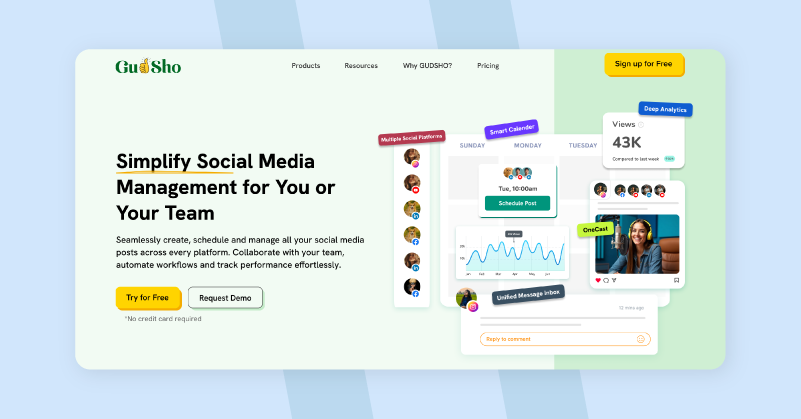
GUDSHO Social is a beginner-friendly social media management platform that combines social media metrics and engagement effectively. You don’t need to switch tabs or jump between accounts to see how your posts perform on each channel. You can view platform-specific analytics at once from a single dashboard and plan your next move with insightful reports.
The unified social media inbox also gathers all comments and engagement in one place, so you don’t have to visit each social account every time to monitor social media engagement.
Moreover, it includes a built-in video editor, video library and other marketing tools that help you promote, manage, track and evaluate your social media performance all within one platform.
Key features:
- Offers Social media scheduling, posting, audience engagement and analytics tracking.
- Measure performance for top social media platforms like Facebook, Instagram, YouTube, LinkedIn and more.
- Centralized social media analytics to track impressions, plays, views, shares, likes and more.
- Platform-specific analytical reports tailored for each social channel.
- Easy, sortable day & month specific report generation for quicker insights.
- Clear pictorial representations, including line graphs that show metric fluctuations over time.
2. Sproutsocial
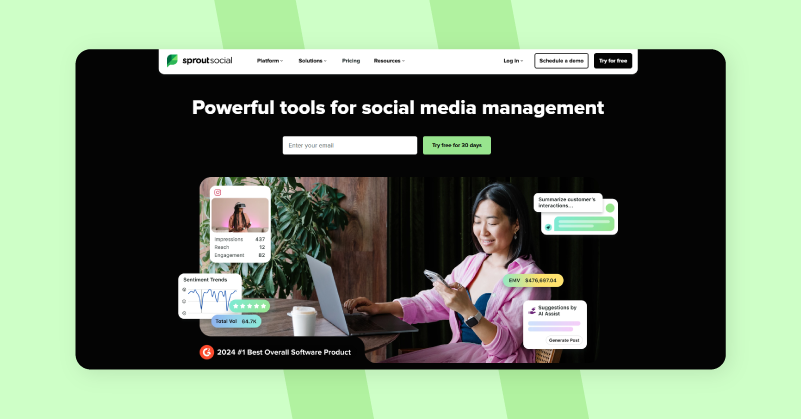
SproutSocial quantifies the impact of social media performance through industry-standard analytics. The platform offers dedicated sections to distinguish between organic and paid performance, allowing you to see how your posts perform in each area.
By gaining deep insights into social media analytics, you can identify the strategies that work best across your social channels. Optimize your next moves based on these reports and make smarter decisions.
SproutSocial lets you analyze volume, performance patterns and campaign effectiveness so you can measure what matters most.
Key features:
- Interactive charts and graphs to visualize social media performance
- Social media performance metrics for 5+ major social media channels
- Hashtag tracking tools available for faster reach
- Competitor performance tracking to gain insights for promotional ideas
- Dedicated section for paid campaign reports to measure performance.
3. Hootsuite

Hootsuite combines comprehensive social media analytics and engagement tools across top social networks to help you focus on ROI measurement and performance tracking.
You can gather centralized data for posts shared across all your social media channels and monitor how your content performs on each. The platform also suggests optimal posting times, such as the best time to post Instagram Reels, YouTube Shorts, Facebook Reels and more. This helps you capture your audience’s attention at the right moment.
Hootsuite also integrates web analytics to measure how your content drives traffic to website and make conversions possible over time.
Key features:
- Helps you measure metrics like views, engagement rate and clicks with detailed reporting.
- Analytics reports highlight audience growth, post engagement and more.
- Allows you to monitor reach, click-through rate, cost per click and other key metrics across top social channels.
- Export social media reports in multiple formats such as .csv, pdf and more.
- Includes a built-in competitive analysis tool to review your competitor’s content strategies.
Measure Social Media Metrics That Work!
We have explored everything from what are social media metrics to how to track social media metrics in one go. We hope you have gathered enough insights to start tracking social media metrics and measuring performance for impactful success.
Rather than focusing purely on viral growth, managing social media metrics and becoming familiar with analytics can ease the burden. Stay stress-free and use your time to create content that creates a bigger impact by measuring the metrics that work for you behind the scenes.
Its time to measure what matters on social media! ?
 Haripriya is a Digital Marketer skilled in video editing tools and social media strategy, focused on boosting social media engagement and driving meaningful brand interactions online.