
“AI voice” used to refer to a flat robotic helper that read the weather. That is no longer the case.
Search engines now employ speech and audio clues to determine which companies appear when a user searches, and brands increasingly use AI-generated voices to release videos more quickly than before.
This is already having an impact on how marketers create marketing videos and how consumers locate information.
Role of AI Voice in Video Marketing
Video work used to hit the same wall almost every time: money.
- Costly voiceovers: Every recording meant booking studio time, hiring talent, and sitting through edits and retakes.
- Slow changes: Testing, translating, or updating a video meant starting half the process over.
AI voice platforms pretty much knocked that wall down, and their adoption is growing fast. One such platform is Murf. The platform covers everything from an AI voice generator for voiceovers to real-time TTS and voice agents.
- Text-to-speech for natural-sounding voiceovers in minutes
- AI voice agents for interactive conversational experiences
- Voice APIs to add voice into existing apps and workflows
How AI Voice Cuts the Cost and Time of Video Marketing
Teams can now do things that used to be out of reach:
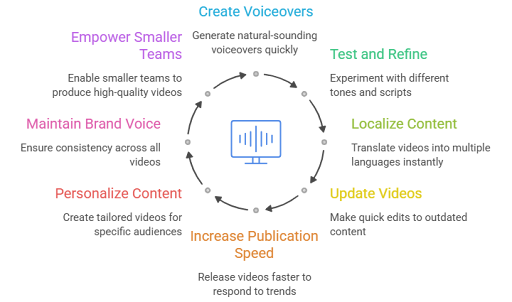
- Faster voiceovers: A decent voiceover takes minutes instead of days
- Easy testing: Try different tones or scripts on the same ad without booking a studio again
- Instant localization: Get a video into several languages without recording a new take
- Simple updates: Patch up an old video without reshooting anything
This changes what a team can afford to attempt, so brands make more video, more often. It matters even more for brands running a large video-on-demand library, where re-recording every outdated clip is off the table.
How AI Voice Is Changing the Way Brands Plan Video Content
The bigger change is in how teams plan video content:
- Publication speed: Work that takes weeks can be online in a matter of days, allowing brands to respond to news almost instantly.
- Personalization at scale: It is now a standard practice to create dozens of video cuts with various names, locations, or offers.
- A unified voice: A brand can sound consistent throughout all videos by using a single unique voice.
- Space for smaller teams: Smaller enterprises are increasingly using inexpensive tools to outsmart big brands. They do not need the same budgets or resources. Two people with a laptop can now produce what once required a full crew.
Traditional Video Marketing vs. AI Voice Video Marketing
| Video Production Factor | Traditional Approach | AI Voice Approach |
| Time to produce a voiceover | 3 to 7 days | Minutes to hours |
| Cost per version | High (studio, talent, editing) | Low (software-based) |
| Localization | Separate recording per language | Instant multi-language generation |
| Updating outdated content | Full reshoot or re-record | Quick script edit and regenerate |
| Testing multiple tones/scripts | Rarely done, too costly | Common, low-cost experimentation |
That covers production. The other shift is about how people come across a brand at all.
How AI Voice Is Reshaping Brand Discovery in AI Search
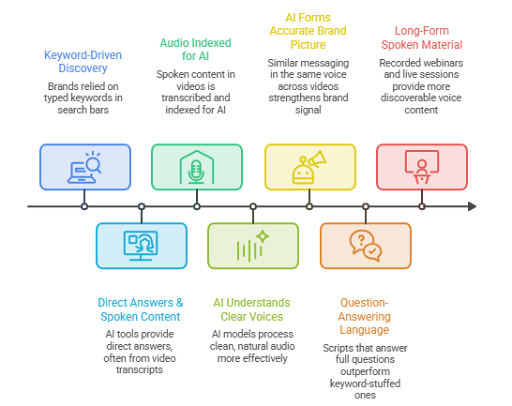
Fewer people now type plain keywords into a search bar. They simply ask an AI tool a question and get a direct answer, so getting “found” means something different now.
Here are the key ways AI voice is changing how brands get discovered.
1. AI Search Pulls Answers From Spoken Video Content
Ask an AI tool “which budget skincare brand works for sensitive skin,” and it won’t hand you 10 blue links. It gives a direct answer, often built from video transcripts, spoken content, and structured brand details.
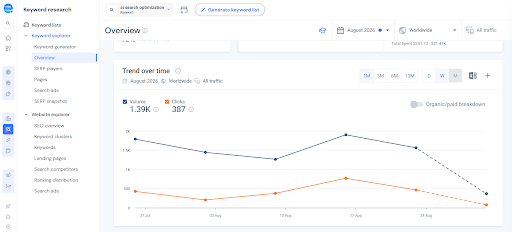
That’s why more marketers use an AI search optimization tool to see how their brand shows up inside these AI-generated answers. Similarweb’s AI Brand Visibility helps teams track brand mentions across AI-generated answers, identify the topics and prompts driving visibility, and see which sources influence those mentions. This gives marketers a clearer view of how their brand appears across AI search and which content can strengthen its visibility.
2. Voiceovers Become Searchable Brand Signals
What’s said in a video gets transcribed and indexed, and that wording can decide whether the video feeds an AI answer. AI tools now read the audio inside videos, not just titles and descriptions, to work out what a brand does and who it’s for.
- Treat every spoken script as SEO content in its own right
- Mention your brand, product, and use case clearly in the voiceover
3. Clean AI Audio Helps AI Tools Understand Your Brand
AI models process clear natural audio far better than a voice buried under noise or loud music. AI-generated voiceovers are clean by default, which makes them easier to transcribe accurately.
4. A Consistent Voice Builds a Clearer Brand Identity
Similar messaging in the same voice across videos helps AI tools form an accurate picture of what a brand stands for. Switching voices every few weeks weakens that signal.
5. Conversational Scripts Match How People Ask AI Tools
People ask AI tools longer and more natural questions than they type into a search box. Scripts that answer a full question tend to beat keyword-stuffed ones.
Here’s how priorities are shifting:
| Focus Area | Old Priority | New Priority |
| Video scripting | Short and punchy taglines | Clear, question-answering language |
| Voice quality | “Good enough” audio | Clean, natural, easy-to-transcribe audio |
| Content volume | A few polished videos per quarter | Steady stream of smaller, voice-driven videos |
| SEO thinking | Keywords in titles/descriptions | Spoken content that matches real questions |
| Brand consistency | Visual branding only | Consistent tone of voice across all videos |
6. Webinars and Live Sessions Add More Discoverable Voice Content
Recorded webinars and live sessions are long-form spoken content too, and they give AI tools even more material to understand your brand. Teams can use StreamYard alternatives to host, record, and repurpose these sessions in one place.
Rethink Marketing and Discovery With AI Voice
AI voice didn’t just make video cheaper. It has become a part of how a brand gets discovered in the first place. AI search tools now listen to the videos that are going out faster and in bigger numbers.
Brands that treat voice as an afterthought will probably fall behind. AI assistants recommend those brands that build it into their content and search strategy.
That’s what has really changed. Not just faster videos, but a different way people end up finding you.
Ready to turn your videos into a discovery engine? Create, host, and promote voice-driven video content in one place with GudSho.